LLM Prices Are in Freefall and the Frontier Labs Are Sweating
The price of intelligence is collapsing faster than anyone in Silicon Valley expected.
A Market Transformed in Weeks
July 2026 has been the most aggressive month in the history of AI pricing. OpenAI opened the floodgates on July 7 by slashing GPT-4o prices by 40 percent. Within days, Google answered by cutting Gemini 2.5 Flash by 60 percent, and Anthropic dropped Claude 3.5 Sonnet by 30 percent. DeepSeek and Mistral followed almost immediately.
Sam Altman didn’t try to hide what was happening. The OpenAI chief signalled the company was prepared to cut prices for its flagship models by as much as 75 percent to counter market gains by Anthropic and low-cost alternatives pouring out of China, the South China Morning Post reported on July 15.
Google, meanwhile, quietly halved its consumer-facing AI Plus subscription from $7.99 to $4.99 a month. The signal was unmistakable: AI is becoming a commodity, and nobody wants to be the one caught charging yesterday’s rates.
The Numbers Behind the Nosedive
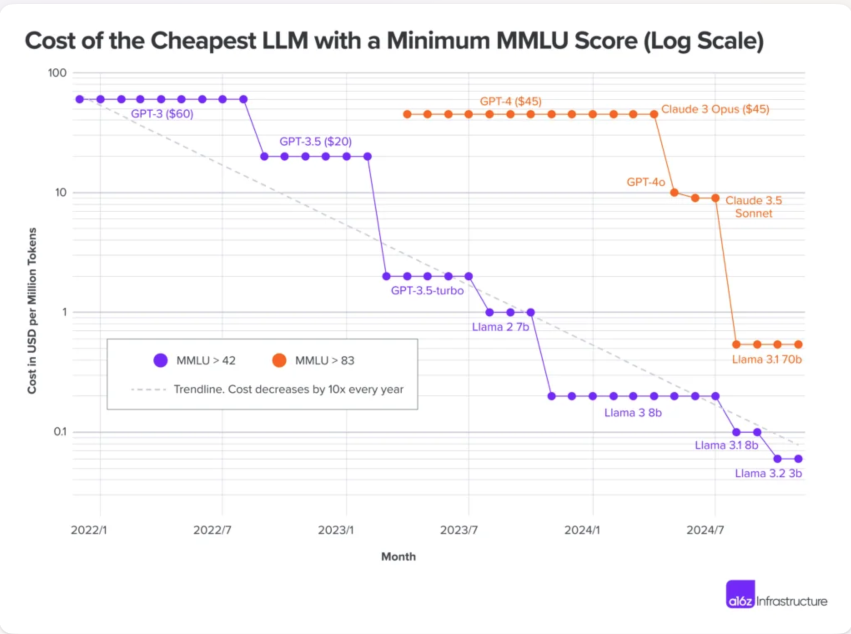
The broader trend is even starker. According to the BenchLM Token Price Index, frontier LLM token prices have fallen 88 percent from their March 2023 baseline. A capability that cost roughly $20 per million output tokens in late 2022 now runs about $0.40 — a 55-fold decline in under four years.
“When DeepSeek released its R1 reasoning model in January 2025 at $0.55 per million input tokens and $2.19 output — against OpenAI’s o1-preview at $15 and $60, launched just four months earlier — it was obvious the market was about to get brutal,” Aman Panjwani, an AI engineer based in India, told The Register.
An academic paper published on arXiv earlier this year documented an approximately 600-fold decline in LLM token prices overall and proposed what the authors call a “Tiered Super-Moore” hypothesis. Economy-tier models now exhibit a price half-life of just 1.10 years, while mid-tier models clock in at 1.55 years. Those are rates of deflation that make even the most aggressive semiconductor roadmaps look glacial.
Three Tiers, One Direction
As of July 2026, the market has effectively sorted itself into three price bands. Closed frontier APIs — think GPT-5.5, Claude Opus 4.8, and Gemini 3.1 Pro — still command $2 to $5 per million input tokens and $9 to $30 per million output. But open-weight models hosted on specialist inference providers like Together AI, Groq, and Fireworks are running 5 to 50 times cheaper, often between $0.05 and $0.60 per million tokens.
OpenAI’s own newly released GPT-5.6 family, which went GA on July 9, tells the story from the inside. The lineup spans three tiers: Sol at $5 input and $30 output, Terra at $2.50 and $15, and Luna — the real eyebrow-raiser — opening a new $1 input, $6 output tier. A year ago, those bottom-tier numbers would have been unthinkable for a frontier lab.
xAI’s Grok 4.5 landed at $2 and $6 with a 500,000-token context window, undercutting GPT-5.4 Mini on output while claiming quality advantages. And DeepSeek V3 can now be had for as little as $0.28 per million input tokens on the open-weight hosting market — a figure that would have been dismissed as science fiction when GPT-4 launched at $60 per million output tokens in March 2023.
Enterprises Hit the Brakes
Behind the pricing drama sits a hard business reality: enterprises are reining in spending. Nearly three-quarters of companies watched their AI costs blow past budget last year, according to the 2026 State of FinOps Report. Many are shifting from what one industry observer called “tokenmaxxing” — running everything through the biggest models — toward smaller, cheaper, and often open-weight alternatives.
“Some of their largest enterprise customers may start limiting their out-of-control token spend,” D.A. Davidson analyst Gil Luria told CNBC in late June, referring to concerns around OpenAI and Anthropic’s growth trajectories.
It’s a brutal moment for the timing. Both OpenAI and Anthropic have raised and spent enormous sums building the world’s most powerful models, betting that owning the frontier would generate massive returns. But as the IPO window inches open, the price of what they’re selling keeps dropping — and the open-weight ecosystem, led by Chinese labs like DeepSeek and Qwen, keeps closing the quality gap at a fraction of the cost.
What Comes Next
The price war shows no sign of slowing. If anything, the gap between what frontier labs charge and what the open-weight ecosystem delivers is widening — and the enterprise customers who write the checks are noticing. The question isn’t whether prices will keep falling. It’s whether the labs that bet billions on being the premium option can survive in a market that increasingly looks like it wants cheap, good-enough, and now.